

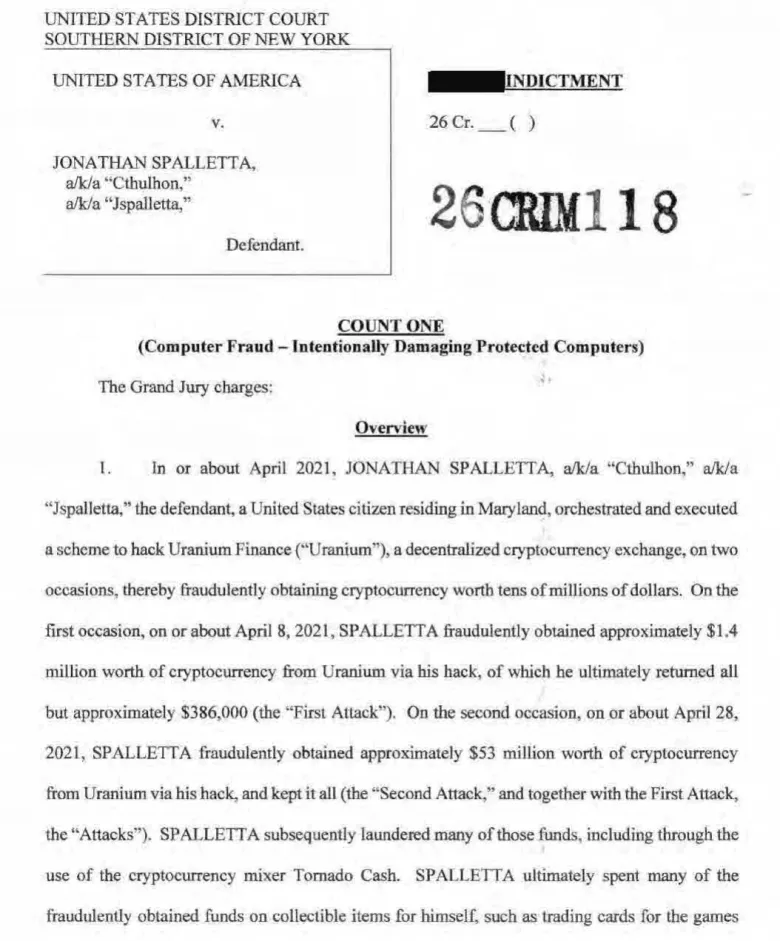
US authorities have officially charged Jonathan Spalletta, who is suspected of hacking the decentralized exchange Uranium Finance in 2021. The breach resulted in the theft of over $53 million, leading to the complete shutdown of the platform.
This is reported by Finway
Case Details: Charges and Hacking Scheme
According to the investigation, Jonathan Spalletta, who operated under the aliases Cthulhon and Jspalletta, is accused of computer fraud and money laundering. If convicted, he faces a maximum prison sentence of up to 30 years: up to 10 years for fraud and up to 20 years for money laundering.
It is known that Spalletta voluntarily surrendered to law enforcement after the charges were filed. According to the US Attorney’s Office, the first attack occurred on April 8, 2021: the hacker exploited a vulnerability in the reward distribution system and withdrew over $1.4 million from liquidity pools. About two weeks later, he informed another individual about a “crypto-theft” amounting to $1.5 million, noting that he had used a bug in the smart contract. In his correspondence, Spalletta also referred to the digital assets as “fake internet money.”
Subsequently, the perpetrator organized a second, larger attack, exploiting vulnerabilities in 26 liquidity pools at once. This allowed him to withdraw approximately $53.3 million, which effectively led to the collapse of the Uranium Finance platform.
“The defendant’s actions are plain theft, and the use of cryptocurrencies does not change the nature of the crime,” emphasized US Attorney Jay Clayton.

Money Laundering and the Case’s Significance for the DeFi Industry
According to case materials, from 2021 to 2023, Spalletta laundered about $26 million through the Tornado Cash mixer, distributing funds among various wallets and blockchains. Part of the acquired assets was spent on collectibles: rare Magic and Pokemon cards, antique coins, and historical artifacts.
In 2024, law enforcement was able to seize crypto assets worth approximately $31 million that were linked to the crime. The tracking of the funds was facilitated by on-chain analyst ZachXBT, who analyzed the routes of asset movement and their withdrawal through intermediaries.
Experts believe that this process could become landmark for judicial practice regarding DeFi exploits. Courts are increasingly viewing the exploitation of vulnerabilities in smart contracts as a crime, especially when accompanied by money laundering and concealment of funds.