

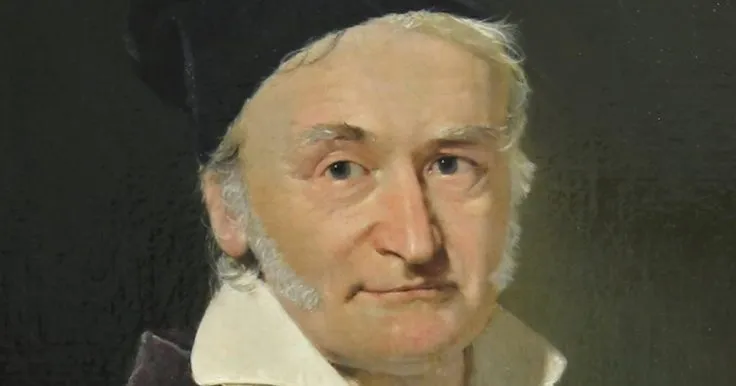
Carl Friedrich Gauss, recognized as one of the greatest mathematicians of all time, was born on April 30, 1777, in Brunswick, Germany. His life journey and contributions to science continue to captivate scholars and historians around the world. Gauss is revered as a genius who made fundamental discoveries in mathematics, physics, astronomy, and geodesy.
This is reported by Finway
“Gauss never published a scientific work until he had perfected it. Because of this, many of the scientist’s great discoveries became known only after his death. Had it not been for Gauss’s perfectionism, mathematics might have advanced 50 years earlier.”
Childhood and the formation of a genius
Carl Friedrich Gauss was born into a family of modest means: his father was a gardener and mason, while his mother could barely read and write. She only remembered that her son was born 8 days before Ascension, the date of which depends on Easter. This fact inspired Gauss in 1799 to invent a method for determining the exact date of his birth by developing a way to calculate the date of Easter for any year.
At the age of 3, Gauss found an error in his father’s financial calculations, demonstrating extraordinary abilities with numbers. At 7, he amazed his teacher by instantly summing all the numbers from 1 to 100 in his head, obtaining a total of 5050. Throughout his life, Gauss performed most complex calculations without the aid of notes.
From 1792 to 1795, the future scientist studied at Collegium Carolinum, now known as the Technical University of Brunswick. He then entered the University of Göttingen, where he defended his doctoral dissertation in 1799.
From 1806 until his death in 1855, Gauss headed the observatory in Göttingen. After the scientist’s death, King of Hanover George V commissioned a medal in honor of Gauss, featuring his portrait and the inscription Mathematicorum Princeps, meaning “King of mathematicians.”
Main scientific achievements of Carl Friedrich Gauss
Mathematics
- At 19, Gauss proved the possibility of constructing a regular 17-gon using only a compass and straightedge. This was the first such breakthrough in geometry since antiquity. Gauss valued this discovery so much that he requested the 17-gon be depicted on his tombstone.
- His doctoral dissertation contained the first rigorous proof of the fundamental theorem of algebra, which states that every polynomial equation has at least one complex root.
- At 24, Gauss published the work “Disquisitiones Arithmeticae,” which laid the foundations of number theory.
- Gauss discovered the intrinsic geometry of surfaces, including the concept of Gaussian curvature, which became key to the development of Riemannian geometry. He also developed the method of conformal mapping, important for cartography.
- His work in differential geometry laid the groundwork for a new science—higher geodesy, and he was among the first to establish the foundations of non-Euclidean geometry.
Statistics and probability
- Gauss created the method of least squares for minimizing errors in measurements, which is widely used in modern statistics.
- He developed and described the concept of normal distribution (bell curve), which became the foundation of probability theory.
Astronomy and physics
- In 1801, when astronomers lost sight of the dwarf planet Ceres, Gauss, applying his own mathematical methods, accurately calculated its location—and the planet was rediscovered exactly where he predicted.
- In astronomy, Gauss worked on celestial mechanics, studying the orbits of planets and their perturbations, and formulated an effective theory for their calculation.
- In physics, he laid the foundations of the mathematical theory of electromagnetism, introduced the concept of electric field potential, and formulated Gauss’s law—one of the fundamental laws of electrodynamics.
- Gauss created an absolute system of measurement, which became the prototype for the CGS system, introducing the basic units of measurement: millimeter, milligram, and second. The unit of measurement for magnetic induction was named after him—the gauss.
- Together with Wilhelm Weber, Gauss built the first electromagnetic telegraph in Germany and made significant contributions to the study of magnetism.