

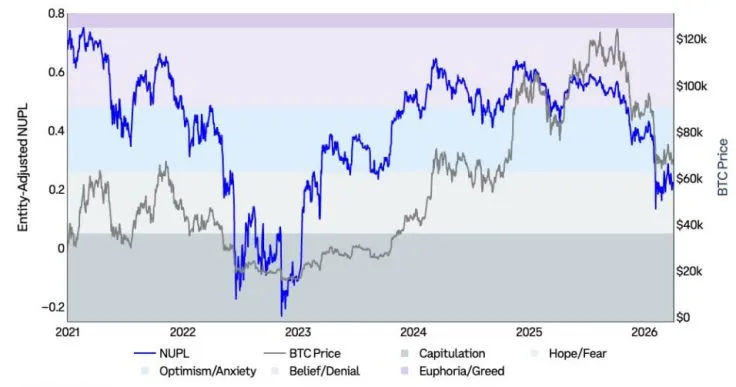
Analysts from Coinbase Institutional and Glassnode have released a forecast for the cryptocurrency market for the second quarter of 2026, describing it as neutral in the context of high macroeconomic uncertainty. Experts emphasize that investors find it difficult to determine a clear strategy due to the significant influence of global economic and geopolitical factors.
This is reported by Finway
Main Macroeconomic Scenario for the Crypto Market
The report highlights that the macroeconomic situation is gradually improving, and technical indicators for both cryptocurrency and traditional stock markets show potential for recovery. Most crypto assets, according to analysts, are close to a local bottom, and it is expected that they may begin to recover in the second half of the current quarter. At the same time, the realization of this scenario significantly depends on the development of the geopolitical situation, particularly the possible stabilization in the Middle East.
Alternative scenarios are also considered:
- Optimistic Scenario: anticipates the end of the conflict in the Middle East, a decrease in oil prices, and a slowdown in inflation rates. This could trigger a broad recovery of risk assets, including cryptocurrencies. Additional market support may come from progress in regulating the industry.
- Pessimistic Scenario: includes an escalation of the conflict, further increases in energy prices, and risks of a global recession. Under such conditions, the crypto market along with other risk assets may face renewed pressure and decline.
Bitcoin and Ethereum Dynamics: Comparative Analysis
According to on-chain metrics, Bitcoin shows signs of potential recovery. The unrealized profit and loss ratio (NUPL) indicator was in the “fear” zone in the first quarter of 2026 but began transitioning to the “optimism” phase in April. According to analysts:
- Bitcoin is in an accumulation phase;
- open interest in the derivatives market has increased by 8.6%;
- active supply has decreased by 37%, indicating the exit of speculative capital;
- long-term investors continue to build positions.
“The report emphasizes that these signals create a positive technical foundation, but remain dependent on macro factors.”

Ethereum, on the other hand, shows a less pronounced recovery. After a capitulation phase in February 2026, the NUPL indicator only began transitioning to the “hope” phase in early April. Experts explain the weaker dynamics as a result of both temporary capital rotation and structural changes — particularly the impact of the network’s utility, regulatory environment, and the integration of tokenized assets. Among the positive signals for Ethereum:
- growth in the supply of stablecoins in the network;
- new highs in the tokenized real assets (RWA) segment;
- preference for second-layer tokens (since October 2025);
- increased concentration of value at the base level of the network.

Investor Assessments and Main Market Risks
As part of the research, a survey was conducted among 91 investors (29 institutional and 62 retail) from March 16 to April 7, 2026. The results showed that by the end of the first quarter, most participants (82% institutional and 70% retail) assess the market as bearish or in the late stages of a downturn — compared to 31% and 36% respectively in December 2025.
Despite negative expectations, a significant portion of investors considers Bitcoin undervalued: this opinion is held by 75% of institutional and 61% of retail participants, while only 7% and 11% respectively consider it overvalued. Additionally, 54% of institutional investors expect Bitcoin’s dominance to remain at the current level, 25% predict an increase, and 21% foresee a decrease.

Among the key risks for the market, three areas are highlighted:
- progress of the CLARITY bill in the US, the implementation of which could positively impact the industry;
- development of post-quantum cryptography, which poses a potential threat to the security of blockchains in the medium term;
- agent-based artificial intelligence, which currently has a limited impact.
It is worth noting that earlier analysts from CryptoQuant noted the approach of the combined Bitcoin index to the historical support zone.