

Monero (XMR) is showing increasing activity despite a number of delistings, and research from TRM Labs has revealed that 15% of network nodes exhibit atypical behavior, which may affect the cryptocurrency’s privacy level.
This is reported by Finway
- 15% of Monero nodes have non-standard network behavior
- About 50% of new darknet markets in 2025 will use only XMR
- XMR’s volatility exceeds that of Bitcoin and Ethereum by 2.5 times
“Despite delistings from exchanges and increased regulatory pressure, activity in the Monero network remains higher than levels seen in 2022.”
Key Trends: Growth in Transactions and Positions in Darknet Markets
According to TRM Labs’ analytics, transaction volumes in the Monero network in 2024-2025 significantly exceeded those of 2020-2021, indicating a sustained demand for this privacy coin even amid stricter regulatory requirements. This is particularly noticeable following mass delistings: in 2025, Monero was restricted or completely removed from 73 exchanges, including Binance, Coinbase, Kraken, OKX, Huobi, and Bitstamp. This has led to a concentration of liquidity on offshore or less compliance-oriented platforms.
At the same time, research shows that 48% of new darknet markets in 2025 operate exclusively with XMR. However, the majority of ransomware payouts still occur in Bitcoin due to greater liquidity and accessibility. Often, ransomware operators encourage payment in Monero by offering discounts, but most transactions still take place in BTC.
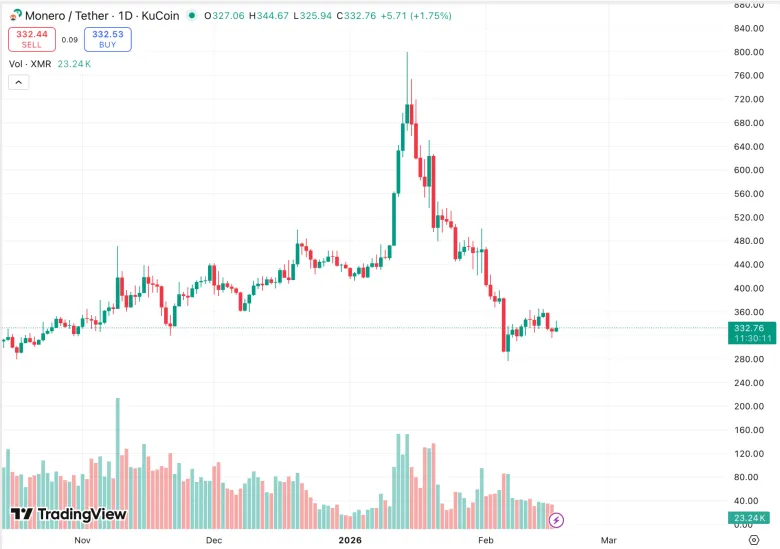
In the past month, Monero’s volatility has been approximately 2.5 times higher than that of Bitcoin or Ethereum, reflecting a thinner market and fragmented liquidity due to delistings. Currently, XMR is trading at $332.

Network Anomalies and Their Impact on Anonymity
In a separate study of the P2P network of Monero, it was found that 14-15% of nodes exhibit atypical behavior concerning protocol standards. This includes deviations in the handshake procedure, message timing, node list composition, and infrastructure concentration. Analysts emphasize that non-standard behavior does not necessarily indicate malicious intent but can create structural visibility for analyzing transaction propagation in the network.
The cryptographic foundation of Monero remains robust; however, researchers stress that practical anonymity depends not only on the blockchain but also on the network layer, where potential anomalies can affect users’ privacy levels.
In September 2025, the Monero network experienced an attack that reorganized 18 blocks, highlighting ongoing security risks for the infrastructure. Despite this, by January 2026, XMR reached a historical high when the coin’s price surged to nearly $600, with daily trading volume increasing by over 243%. Experts attribute this growth to both the overall recovery of the crypto market and issues faced by its competitor, the Zcash project.