

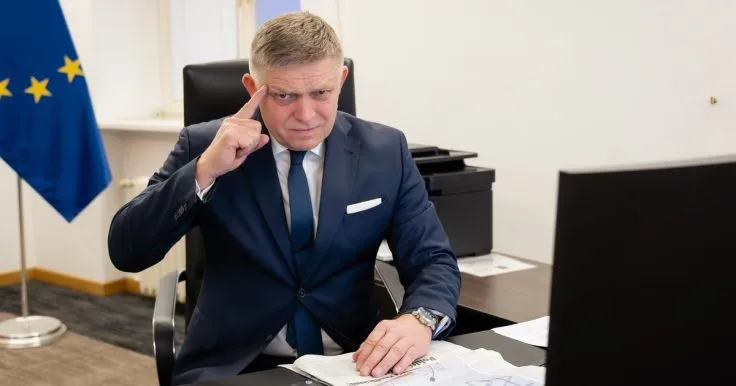
Slovak Prime Minister Robert Fico is forced to fly to Moscow via a complicated route due to a number of restrictions imposed by European countries. Several EU states refused to grant permission for the government plane to pass through, complicating the organization of the trip to the Russian Federation for the May 9 celebrations.
This is reported by Finway
Fico’s Route: Restrictions and Approvals
According to the Slovak publication Marker, the Slovak delegation will fly to Moscow via the Czech Republic, Germany, Sweden, and Finland. This route was developed after the Baltic states – Lithuania, Latvia, and Estonia – closed their airspace to the Slovak Prime Minister. Poland also did not support the flight to Russia, although this was not officially reported.
Estonia took a particularly tough stance. The country’s Foreign Minister Margus Tsahkna emphasized that Tallinn would not allow Fico’s plane to fly over its territory on the way to Moscow. In its statement, the Estonian authorities stressed that the May 9 celebrations in Russia are an element of the aggressor state’s policy.
“Russian festivities today are not just a commemorative date, but part of the policy of the aggressor state.”
Robert Fico criticized the decisions of neighboring countries a few weeks ago, noting that he did not understand why EU members could prohibit the flight of a Prime Minister from another member state of the union. He pointed out that Lithuania and Latvia officially denied permission, and according to Marker, Poland also reacted negatively to the visit of the Slovak politician.
The Position of Western Countries and the Influence of Energy
In contrast, the Czech Republic, Germany, Sweden, and Finland agreed to allow Fico’s plane to pass without further discussions. Some Western politicians even expressed interest in a possible exchange of information after Fico’s contacts with Russian representatives.
Marker paid special attention to Germany’s position, which has been experiencing difficulties since May due to the cessation of oil supplies via the northern branch of the Druzhba pipeline. This has created risks for fuel supply in Berlin and Brandenburg, which largely depend on the PCK refinery in Schwedt. As a result, more pragmatic statements regarding cooperation with Slovakia have begun to emerge in Germany, especially against the backdrop of Fico’s visit to Bavaria.
This is not Fico’s first similar trip: last year he reached Moscow via Hungary, Romania, and the Black Sea region, and even earlier – through Turkey to meet with Vladimir Putin. During the current visit, a brief meeting with the President of the Russian Federation is planned.