


Archaeological research in Frankfurt am Main has yielded unique findings that change the understanding of early Roman presence in the region. During restoration work at the “Bologna Palace,” archaeologists stumbled upon the remains of a Roman military camp, which is now considered the oldest known within the city limits.
This is reported by Finway
The Historical Significance of the Discovery for Frankfurt
The discovered camp has provided a new impetus for research into the first contacts between Rome and the Germanic peoples. During the excavations, a whole range of artifacts was recorded, indicating organized life and the prolonged presence of Romans in this area. Among the findings are imported coins from modern-day France and Belgium, as well as exquisite pottery from Southern Gaul.
These items confirm that the camp was not merely a temporary outpost but part of a large Roman supply and trade system. Frankfurt’s Mayor Mike Josef emphasized the importance of the discovery for studying the spread of Roman influence in the region during the reign of Emperor Augustus.
“A unique testimony to early Roman history in Höchst,” — characterized the finding Mike Josef.
Details of the Excavations and Features of the Camp
Roman military camps from the early period are extremely rare to preserve, as they typically functioned for a short time and left minimal traces. However, in this case, scientists managed to find a number of evidences of a more prolonged military presence. The location of the camp near the Nidda and Main rivers provided ideal conditions for transportation, observation, and supply. The elevated terrain and access to waterways gave Roman units a strategic advantage, allowing them to control the territory and move swiftly across it.
Archaeologists suggest that both Roman legionaries and auxiliary troops were present in the camp, which is characteristic of the Roman army of that period. Furthermore, the found local pottery and food remains indicate not conflicts, but cooperation between the Romans and the local inhabitants. According to archaeologist Andrea Gampel, no signs of destruction or traces of violence were found. This provides grounds to believe that the first contacts between Romans and Germanic tribes were often peaceful and accompanied by the exchange of cultural customs.
The research has become part of a large-scale project that has been ongoing since 2016 under the leadership of Elke Siehert, in collaboration with experts Denis Neumann and Rolf Skripzak. The team combined modern archaeological methods with careful conservation of artifacts. Due to the dense urban development, such excavations in Frankfurt are extremely rare, making the finding particularly valuable for science.
The discovery proves that even in ancient times, the territory of Frankfurt played an important role in the border policy of the Roman Empire. The findings indicate that Roman influence extended deep into Central Europe, expanding the understanding of the early expansion of the empire to the north.
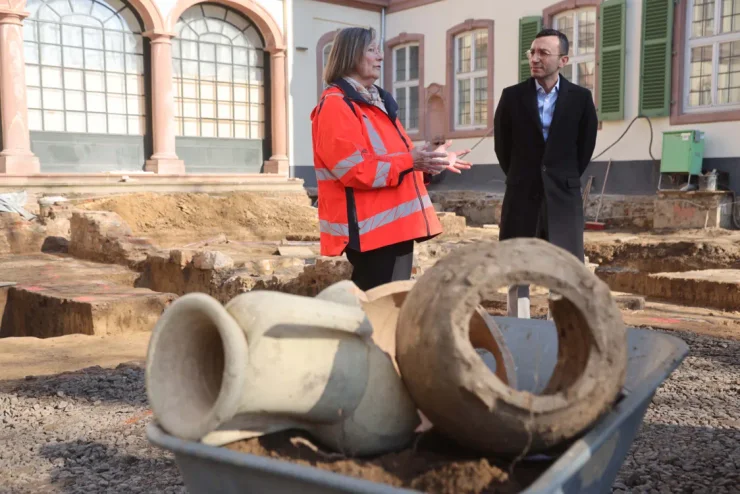
The camp was found during restoration work at the historic “Bologna Palace.” Photo: City of Frankfurt am Main, Maik Reuß