

Analysts at Santiment reported a significant decline in sentiment among market participants regarding the cryptocurrency XRP. According to the latest data, the ratio of positive to negative comments about this asset has decreased to 1.1, indicating a predominance of pessimistic expectations.
This is reported by Finway
Increase in pessimism among traders
Experts at Santiment note that the current level of fear and skepticism is often observed as a signal for a potential trend change in the price of XRP. Typically, during such times, some “weak-handed” traders exit the market, which can reduce selling pressure and create conditions for stabilization or short-term price growth. However, experts warn that excessive confidence and mass buying FOMO can also lead to local peaks and a lack of new buyers.
“When the ratio of positive to negative sentiment goes deep into the FOMO zone, it usually means that traders become overly confident and actively buy out of fear of missing profits. Such moments often coincide with local peaks, as too many participants are already positioned for growth, and there are fewer new buyers who can support further price increases,” the experts noted.
Lowest XRP liquidity on Binance since 2020
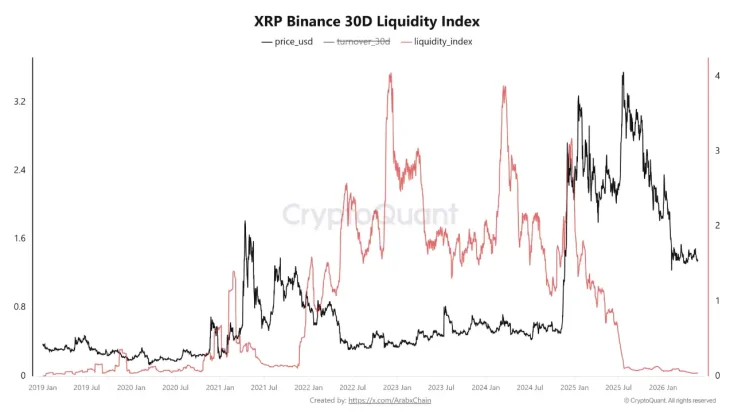
Experts at CryptoQuant have drawn particular attention to the liquidity situation of XRP on the largest cryptocurrency exchange, Binance. According to their observations, the 30-day liquidity index of the asset has dropped to 0.043 — the lowest since January 2020.

This drop in the index indicates a significant reduction in market depth and liquidity available for trading XRP. In previous years, the indicator was significantly higher, especially in 2022-2024, when it exceeded 3-4 points due to increased trading activity and volatility. However, in recent months, the index has sharply declined, which may indicate a decrease in speculative interest and the influx of new funds into the XRP market.
CryptoQuant emphasizes that while low liquidity is not always a clear bullish or bearish signal, prolonged periods at minimal levels make the market more sensitive to large orders. In conditions of low market depth, such orders have the potential to cause sharp price fluctuations.