

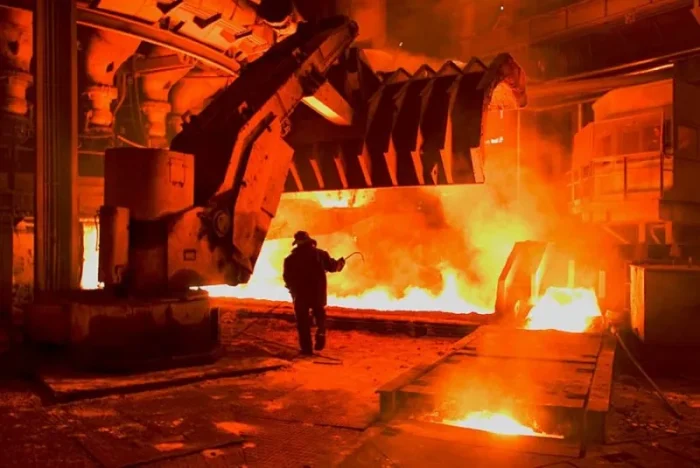
The Russian metallurgical industry is facing new challenges: the largest enterprises are forced to reduce production capacities due to a decline in domestic demand and export restrictions.
This is reported by Finway
Production and Personnel Cuts
One of the industry leaders, Magnitogorsk Iron and Steel Works (MMK), has begun to halt part of its production capacities, limit investment programs, and reduce management staff by 10%. According to the company’s management, these actions have become necessary due to the difficult market situation. MMK’s General Director, Pavel Shilyaev, noted that the state of the industry is extremely challenging and reflects the overall economic situation in Russia.
“Steel production is the most sensitive barometer of the economic situation, and the current state of the industry is very complex,” said the company’s General Director Pavel Shilyaev.
At present, MMK is operating at only 60% of its capacity and remains unprofitable. The company has already put one of its coal mines on standby, halted part of its equipment, and placed others on a reduced work schedule.
Impact of Macroeconomic Factors and Government Policy
Experts note that the industry is affected by both the high interest rates set by the central bank after the economic overheating in 2024 and the global steel surplus. An additional negative factor remains the sanctions, which have significantly restricted the export opportunities of Russian producers.
According to estimates by PAO Severstal, steel consumption in Russia fell to its lowest level since 2020 in 2025. Last year, the company reported the worst profitability in the last 16 years. Despite this, the government of the Russian Federation is currently not providing broad tax incentives to steel producers, leaving the possibility of support only in specific cases.
The metallurgical industry is not key to the gross domestic product; however, it provides jobs for hundreds of thousands of people, primarily in cities whose economies are entirely dependent on a single large enterprise. Analysts warn that without government support, Russian metallurgy may revert to the levels seen in the early 2000s.