

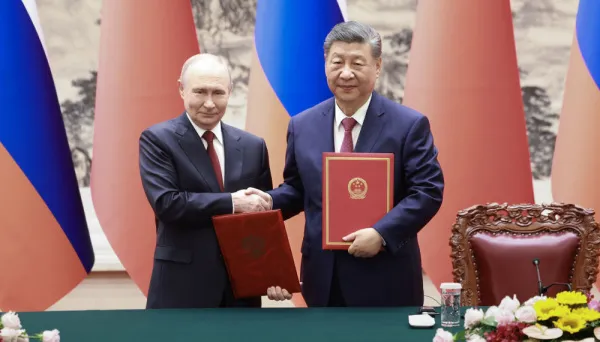
Russia and China have signed an agreement for the joint creation of a new railway branch that will run through their common border. The document was signed in Beijing during an official ceremony attended by the leaders of both countries — Xi Jinping and Vladimir Putin.
This is reported by Finway
New transport corridor between Zabaikalsk and Manchuria
The project involves laying a second railway line with standard Chinese gauge, which will connect Zabaikalsk in the Russian Far East and Manchuria in Inner Mongolia, China. According to the Russian Ministry of Transport, this initiative aims to increase the capacity at the border, which is currently the busiest railway crossing point between the two countries and plays a key role in trade connectivity.
Currently, due to the difference in gauge — 1520 millimeters in Russia and 1435 millimeters in China — cargo must be reloaded at the border, which slows down the movement of goods. The new branch will allow for increased transportation volumes and reduced transit time.
Development of trade and infrastructure
The Russian transport agency expects that by 2030, the new railway line will increase annual capacity by 11 million tons, which is equivalent to nearly 50 additional pairs of freight trains per day. Such changes are expected to significantly impact logistics between Russia and China, considering that the volume of bilateral trade has increased by more than 50% since Russia’s full-scale invasion of Ukraine, exceeding 200 billion dollars a year.
It is worth noting that trade turnover between the countries has long been constrained by limited railway infrastructure capabilities. In response to Western sanctions, which have intensified Moscow’s dependence on China, Russia is increasingly utilizing railway routes for the export of raw materials, including coal, aluminum, and agricultural products, to China. Additionally, both countries aim to develop joint infrastructure projects in the Russian Far East, including grain terminals, processing facilities, and supply routes to China.
It should also be noted that during Vladimir Putin’s visit to Beijing, agreements were signed regarding veterinary and sanitary requirements for Russian exports of animal feed, which may also contribute to the growth of this trade sector.
“Xi Jinping called for China and Russia to deepen their comprehensive strategic coordination and work towards making the global governance system fairer and more rational.”