

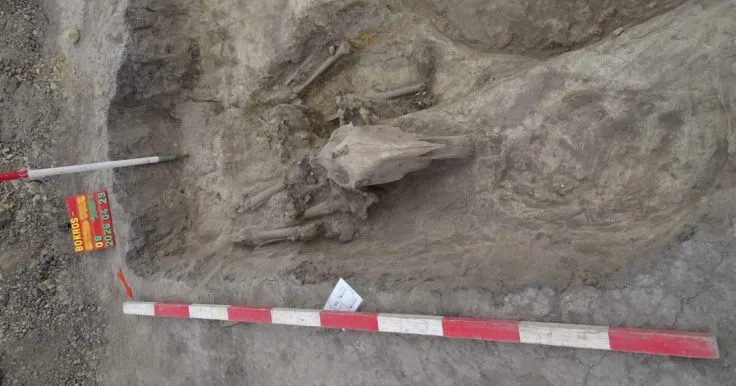
In southern Hungary, near the town of Chongrad-Bokros, archaeologists have found an extremely valuable burial of an elite horseman from the time of the Hungarian conquest. This discovery provides new information about the early settlement of Hungarian tribes in the Carpathian Basin and has already been recognized as one of the most important archaeological finds in the region in recent years.
This is reported by Finway
The Discovery and Significance of the Grave
The excavations, which took place in April and May under the leadership of Dr. Csaba Salontai and Martin Borsodi from the Tári László Museum, have determined that the burial belonged to a high-ranking horseman. He was accompanied by rich burial gifts, including a gold ring and silver ornaments. Despite some damage, the key part of the burial has been preserved and contains unique artifacts, making this grave the oldest and most prestigious among known burials of Hungarian conquerors in this region.
For the first time, archaeological items were discovered here in 2024 by treasure hunters Lajos Lenart and Judit Centes on an arable agricultural plot. After this, local historian Ferenc Zigo joined the research, helping to map the locations of the found artifacts and analyzing the extent of the grave’s disturbance.
“The preserved finds make this site particularly important, as it is currently considered the oldest and most prestigious grave associated with Hungarian conquerors ever discovered in the Chongrad district.”
Unique Finds and Historical Context
The collaboration between archaeologists, local researchers, and metal detectorists has allowed for the rescue of important artifacts that could have been lost due to agricultural activities. Preliminary assessments by the museum indicate that among the finds are several rare items of Eastern origin, and some may prove to be unique to the region. The burial customs recorded at this site reveal new aspects of the cultural connections and migrations of early Hungarian communities.
Graves from the period of the Hungarian conquest are particularly significant for studying the 9th–10th centuries, as there are few historical records from this era. The burials allow for tracing social status, military equipment, cultural identity, and rituals of that time. Horsemen were traditionally buried with weapons and equestrian gear, highlighting their role in society.
Chongrad, located by the Tisza River, has historically been an important route for movement and cultural interaction. The burials in this area help explore how early Hungarian groups integrated and interacted with the local population, forming elite networks in the southern Great Hungarian Plain.
Further research will include laboratory analysis of the artifacts, their conservation, and comparisons with other finds from the corresponding period. Despite the damage caused by later agricultural work, the burial in Chongrad-Bokros has already become a key source for studying the early history of Hungarian communities in the Carpathian Basin.