

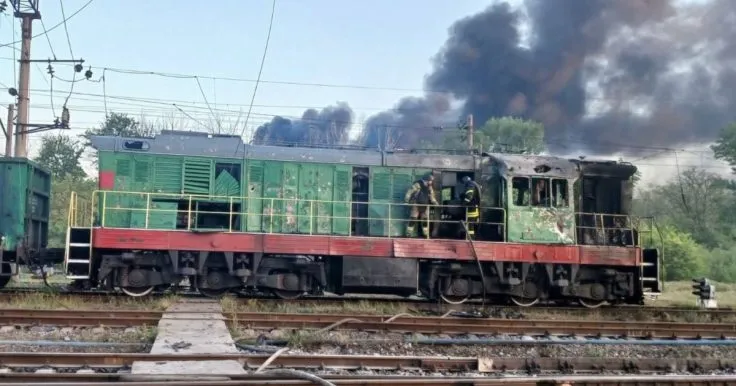
On the morning of May 12, Russian troops struck railway infrastructure facilities in the Dnipropetrovsk region. This was reported by the Minister for Communities and Territories Development, Oleksiy Kuleba. As a result of the attack, debris injured a train driver who was heading to a shelter. He is receiving the necessary medical assistance, and his life is not in danger.
This is reported by Finway
“The monitoring team warned about the danger in advance. However, the train driver was injured by debris while heading to a shelter. He is currently receiving the necessary assistance, and his life is not in danger.”
According to the minister, during the attack, a drone hit locomotives and rolling stock. This caused damage to the equipment, but train operations in the region are being promptly restored.
Scale of attacks on railway infrastructure
Russian military forces regularly strike Ukrainian cities and civilian infrastructure, including railways, using various types of weapons: strike drones, missiles, guided bombs, and multiple launch rocket systems. Such attacks pose a threat to the lives of infrastructure workers and civilians, as well as causing damage to critical facilities.
War crimes and signs of genocidal actions
The Ukrainian authorities and international organizations classify such strikes as war crimes of the Russian Federation, emphasizing their targeted nature. Shelling of life-support systems and healthcare facilities aimed at depriving people of electricity, heat, water supply, communication, and medical assistance contains signs of genocidal actions.
In particular, the following manifestations are recorded: declarations of intent to destroy Ukrainians and public calls for this, systematic shelling of infrastructure, destruction of the intelligentsia, deportation of children, confiscation of Ukrainian books and historical artifacts. Human rights experts believe that these actions fall under the definition of genocide as formulated in the Convention on the Prevention and Punishment of the Crime of Genocide, adopted by the UN in 1948.
According to the convention, genocide is recognized as acts committed with the intent to destroy, in whole or in part, a national, ethnic, racial, or religious group. Among the signs of genocide are: killings, causing serious bodily harm, creating conditions aimed at the destruction of the group, preventing childbirth, forcibly transferring children, as well as publicly inciting such actions.
The leadership of Russia denies the fact of targeted strikes on the civilian infrastructure of Ukrainian cities and villages, despite numerous evidence of the destruction of hospitals, schools, energy facilities, and other vital systems.