

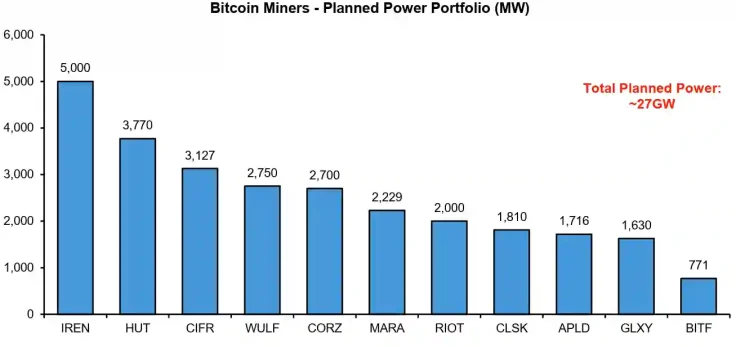
- Bernstein experts claim that access to electricity is the main barrier to the development of artificial intelligence.
- Public miners control over 27 GW of planned capacity.
- Industry companies have already signed AI contracts worth over $90 billion.

Leading bitcoin mining companies are gradually transforming into strategic players in the artificial intelligence infrastructure market. This has been made possible by their access to substantial amounts of electricity and the presence of data centers.
This is reported by Finway
According to Bernstein’s analytical report, the key factor limiting the scaling of modern data centers for AI development is not the shortage of chips, but rather the limited connectivity options to the power grid. Public mining companies currently control over 27 GW of planned energy capacity, making them important players for new AI projects.
In addition, industry representatives have already announced deals related to artificial intelligence infrastructure worth over $90 billion. This involves about 3.7 GW of capacity being used to collaborate with AI developers, cloud solution providers, and chip manufacturers.
“Analysts Gautam Chhugani, Mahika Sapra, Sanskar Chindaliya, and Harsh Misra calculated that public mining firms control over 27 GW of planned capacity.”
Electricity as the Main Resource for AI
According to Bernstein, the wait time for connection to the power grid to obtain gigawatt-level capacities can exceed 50 months even in regions that are friendly to data centers, such as Texas. This creates additional challenges for the development of new sites and strengthens the role of those companies that already have access to the necessary resources.
Another factor slowing down the industry has been the increasing attention from regulators and community protests against the construction of large-scale data centers. In such conditions, miners are actively diversifying their business after the bitcoin halving in 2024, which reduced mining rewards and increased competition in the sector.
Miners’ Shift to AI Infrastructure
Numerous companies are already transforming their traditional bitcoin mining activities towards creating powerful infrastructure for artificial intelligence and high-performance computing. Among the examples is Soluna Holdings, which increased its revenues by 58% in the first quarter of the year, mainly due to data center hosting services rather than cryptocurrency mining.
Analysts are paying special attention to the company IREN, which, after signing multi-billion dollar contracts with Microsoft and Nvidia, has gained significant positions to transform a substantial part of its business into AI infrastructure.
According to a RAND study, by 2030, the U.S. plans to add about 82 GW of new clean energy capacity, which could significantly impact the industry’s development.
It is worth noting that Core Scientific announced the acquisition of miner Polaris for $420 million to expand infrastructure for the needs of the AI sector.