

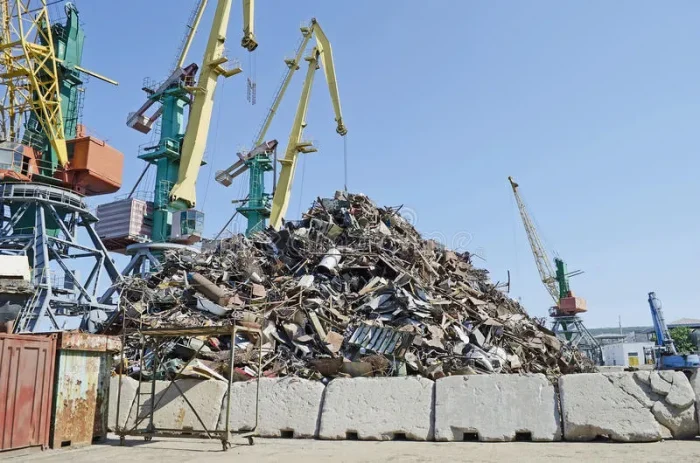
Global scrap metal consumption in 2025 increased by 4.5% compared to the previous year, reaching 480 million tons, despite a 2.5% decrease in global steel production. According to the Bureau of International Recycling (BIR), leading economies played a key role in this dynamic.
This is reported by Finway
Leading Positions: China, India, and Turkey
China maintained its status as the world’s largest consumer of scrap metal, increasing its usage by 8.3% to 227 million tons. At the same time, steel production in the country decreased by 4.4%. India also demonstrated significant growth in both scrap consumption and steel production.
According to the report, the main countries and regions mentioned in the study account for about 75% of global scrap metal consumption in metallurgy.
“BIR’s own calculations and Worldsteel data indicate that approximately 630 million tons of scrap metal are used annually in global steel production, avoiding emissions of nearly 950 million tons of CO2 while saving energy and natural resources,” the publication notes.
The share of scrap in steel production varies significantly depending on the technology. For example, in Turkey, this figure is traditionally high at 86.8%, while in China it remains low at 23.6%. This is explained by the preference for the converter method of steel production in China, which requires significantly less scrap than the electric arc furnace method.
Global Trade: Importers and Exporters
In 2025, Turkey remained the largest importer of scrap metal, although it reduced its purchases from the external market to 18.8 million tons. The main suppliers to Turkey were the USA (down 20.4% to 3.6 million tons) and the Netherlands (down 0.1% to 2.8 million tons). India ranked second among importers, importing 8 million tons, which is 5% less year-on-year. In particular, supplies from the USA decreased by 11.4% (to 1.3 million tons), and from the UK by 11% (to 0.9 million tons).
The European Union increased its scrap metal imports by 28.8% last year to 5 million tons. Meanwhile, in the USA, the figure rose by 5.1% (to 4.7 million tons), and in Pakistan by 39.8% (to 3 million tons). In contrast, Taiwan and South Korea showed a decrease in imports: in Taiwan by 38.1% (to 1.9 million tons), and in South Korea by 17.4% (to 1.8 million tons).
The EU maintained its position as the world’s largest exporter of scrap metal, even considering a 2% decrease in total exports to 16.7 million tons in 2025. The main export destinations were Turkey (down 0.9% to 10.8 million tons) and Egypt (up 13.4% to 1.9 million tons). The Netherlands remains the leading individual exporter within the EU, increasing supplies by 4.4% to 3.9 million tons.
The USA holds second place among global exporters, but export volumes fell by 18.4% to 11.8 million tons. The main buyers of American scrap metal remain Turkey and Bangladesh.
Additionally, last year saw an increase in scrap exports from Japan (up 18% to 7.7 million tons), the UK (up 4.4% to 6.5 million tons), Mexico (up 34.1% to 1.6 million tons), and Singapore (up 33.3% to 1.3 million tons). Meanwhile, Canada and Hong Kong experienced negative dynamics: in Canada, export volumes decreased by 5.4% (to 4.3 million tons), and in Hong Kong by 8.7% (to 1.1 million tons).