

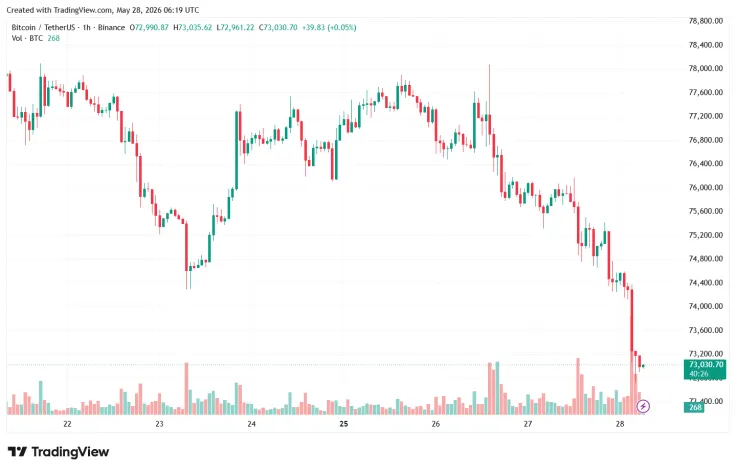
The ceasefire between Iran and the US is under threat following missile strikes that occurred on the night of May 28, 2026. The reaction of financial markets was swift: a significant correction is observed in both cryptocurrency and stock markets.
This is reported by Finway
Bitcoin Price Drop and Its Impact on the Crypto Market
On the morning of May 28, the price of Bitcoin briefly dropped to $72,728, according to TradingView data. Experts attribute this decline primarily to the escalation of tensions between the US and Iran, which calls into question the achieved ceasefire and future agreements.
On the daily chart, Bitcoin’s price drop amounted to nearly 2%, while over the week it was 5.8%. Despite this, at the time of preparing this material, the asset’s price had partially recovered, returning to the $73,000 level.

The correction also affected other leading crypto assets – in some positions, the decline exceeded 7%. Amid market instability, a wave of liquidations of futures contracts is observed: over the course of a day, the volume of losses exceeded $934 million, with most forcibly closed positions being ‘longs’.


The fear and greed index also had an additional impact on the market, dropping six points and plunging into the ‘orange’ zone, indicating an increased level of nervousness among investors.

Impact on Global Markets and Escalation in the Middle East
The correction also affected stock markets: futures on the S&P 500 index lost 0.12%, while Nasdaq 100 dropped 0.4%. At the same time, crude oil prices for WTI surged over 3%, and Brent rose by 2.2%. The yield on ten-year US Treasury bonds increased by 0.7%, indicating rising inflation expectations.
“On the night of May 28, 2026, Reuters reported, citing its sources, that the US struck four drones in the Strait of Hormuz area. A drone launch facility in the Bandar Abbas area was also targeted. Sources emphasized that the action was defensive in nature and was allegedly aimed at preserving the ceasefire.”
In response, the Islamic Revolutionary Guard Corps of Iran launched a retaliatory strike on an American airbase, likely located in Kuwait. Additionally, Iranian military forces attacked vessels attempting to enter the Persian Gulf without permission.
In response, the US Department of the Treasury’s Office of Foreign Assets Control imposed sanctions on the Persian Gulf Strait Authority (PGSA) – the Iranian organization responsible for the transit of vessels through the Strait of Hormuz. Earlier, Iran announced its intention to charge fees for passage in cryptocurrency.
Adding to the overall instability were reports of Israeli strikes on Lebanese territory. The situation in the Middle East remains tense, continuing to impact global financial markets.