

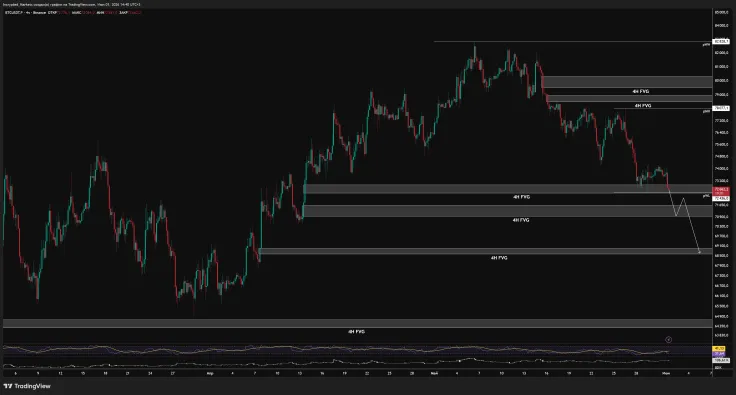
A new month has begun in the crypto market, and participants are observing a decline in Bitcoin’s dominance, an increase in altcoin activity, and the impact of macroeconomic factors from the US. Last week, Bitcoin failed to test the $78,000 zone, after which the market shifted to a short scenario. Local positions were partially closed around $73,000, while altcoins began to show momentum amid the decline in the dominance of the main cryptocurrency.
This is reported by Finway
“Disclaimer: This material is not financial advice or a call to action. The analytics presented are the private opinion of the author. Incrypted is not responsible for the investment decisions of readers.”
Bitcoin: Development Options Amid Declining Dominance
The market heat map indicates large clusters of liquidity below $72,000. If the price breaks these levels, further decline to $69,000–$70,000 is possible — this is the zone for closing the majority of short positions. An alternative scenario suggests a V-shaped rebound and consolidation in the $72,000–$73,000 range, transitioning into sideways movement between $70,000 and $75,000. In this corridor, manipulations with spikes in both directions are possible, intensified by macroeconomic triggers.
Ethereum: Key Levels and Strategies
Ethereum is currently holding its structures better than Bitcoin. The asset continues to test the $2000 level without removing liquidity around $1880. Two main scenarios: a rebound amid capital flow from Bitcoin to altcoins, which could create false expectations of an “altseason,” or a strong downward impulse that breaks the equal lows and opens the way for further decline.
Working with V-shaped recoveries remains challenging, as market makers are collecting liquidity without forming a clear trend. The situation is complicated by several factors: expectations of worse-than-forecasted US labor market data, stagnation in geopolitical agreements, the unresolved issue of US national debt, the summer period of low liquidity, and the overheating of the S&P 500 index.
Impact of US Macroeconomic Data and Dollar Index
The main driver of the week will be the reaction of the Dollar Index (DXY) to macroeconomic data from the US labor market and the rhetoric of the Federal Reserve. DXY is trading near 99.00 in a narrow range, and the following scenarios will determine market sentiment:
- Scenario A: DXY tests last week’s highs (99.50) and after a false breakout corrects downward to 97.40, supporting the crypto market.
- Scenario B: The index first lowers liquidity levels, then V-shaped reverses and updates highs above 99.60 — this is a trigger for further declines in cryptocurrencies.
- Scenario C: A non-retracement rise of DXY to 100.200+ against the backdrop of the Fed’s hawkish rhetoric and inflation, creating pressure on all risk assets.
Calendar of Key Events for the Week
- June 1 (Monday): Debut speech by Fed Chair Kevin Warsh, publication of PMI in manufacturing.
- June 2 (Tuesday): JOLTS job openings report.
- June 3 (Wednesday): ADP employment data, PMI in services.
- June 4 (Thursday): Unemployment claims.
- June 5 (Friday): Non-Farm Payrolls, unemployment rate, hourly wages.
The market expects that weak employment data will increase the likelihood of a dollar decline and support cryptocurrencies. However, if the statistics are strong, DXY could rise significantly.
In this situation, traders are advised to move stop losses to breakeven on open shorts in Bitcoin, and to look for new entry points only after technical pullbacks. Special attention should be paid to altcoins with the potential for impulse growth amid capital rotation, adhering to strict risk management.
Amid low summer market liquidity, aggressive trades with altcoins during the release of key macro data are associated with increased risk. The optimal tactic is to wait for Friday’s US labor market statistics and assess the dollar’s reaction, making trading decisions only after confirming the structure on four-hour timeframes.