

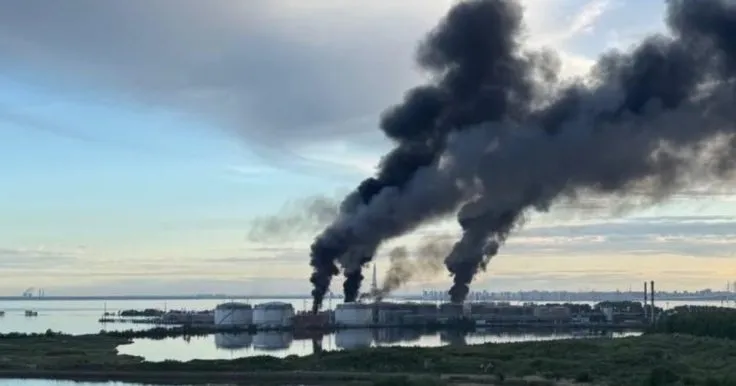
On the night of June 3, Russian St. Petersburg was subjected to a massive drone attack, resulting in damage to critical infrastructure, including the “St. Petersburg Oil Terminal.” The incident occurred on the opening day of the St. Petersburg International Economic Forum, which was scheduled to be attended by Russian President Vladimir Putin.
This is reported by Finway
Details of the Night Attack and Consequences
Explosions were heard in various districts of the city, including Admiralteysky and Vasileostrovsky. Local residents reported powerful sounds and a fire at the oil terminal. According to authorities, there are injuries, but no fatalities. St. Petersburg Governor Alexander Beglov stated that drones struck several infrastructure facilities in Kronstadt, Kirovsky, and Krasnoselsky districts of the city, without specifying which facilities were affected.
“Several facilities were damaged. Cleanup is currently underway. Several people were injured. There are no fatalities.”
At the same time, dozens of flights were delayed at Pulkovo Airport, and nine aircraft were forced to land at alternate airfields. Additionally, mobile internet service was restricted in the city, and residents complained about the inability to connect even to permitted resources.
Confirmation of the Strike and Ukraine’s Involvement
Ukrainian President Volodymyr Zelensky officially confirmed the strikes on targets in Russian territory, including in St. Petersburg. According to him, the operation involved the Security Service of Ukraine, Drone Forces, Special Operations Forces, the Main Intelligence Directorate, and the State Border Guard Service. Zelensky emphasized that important oil industry facilities in Russia, which support the war against Ukraine, were targeted, as well as military objectives at the Kronstadt base.
Among other targets of the attack is a facility in the Tambov region involved in the production of weapons for the Russian army. This facility is located nearly 600 kilometers from the front line.
According to local media, the attack was one of the largest in St. Petersburg. The “St. Petersburg Oil Terminal,” which was damaged as a result of the shelling, is one of the largest transshipment facilities for liquid cargo in the Baltic region, with 21 storage tanks for petroleum products and a total capacity of 12.5 million tons per year. The terminal is about 17 kilometers from the venue of the economic forum.
Governor of the Leningrad region Alexander Drozdenko reported the downing of 50 drones over the region that same night.
Other Consequences of Attacks in Russian Regions
A fire broke out at the “Progress” factory in Michurinsk, Tambov region. According to Governor Yevgeny Pervyshov, residential buildings, a library, an art school, and utility buildings of the enterprise were damaged due to the falling drones, but there were no injuries.
In Smolensk region, according to Governor Vasily Anokhin, two employees of the Ministry of Emergency Situations were killed after drone debris fell during firefighting efforts, while two rescuers and one local resident sustained minor injuries.
Additionally, in the city of Yenakiieve, located in the temporarily occupied part of Donetsk, the head of the region controlled by Russia, Denis Pushilin, claims that a drone attacked a bus on the “Moscow – Simferopol” route. He stated that seven people were killed and another 11 were injured. These figures have not been confirmed by independent sources, and Ukrainian authorities have not commented on them.
The Russian Ministry of Defense stated that during the night of June 3, air defense forces shot down 354 Ukrainian drones over various regions, including Leningrad and Moscow regions, but did not specify how many reached their targets.
Since the beginning of the full-scale invasion of Russia, airstrikes have regularly occurred on the territory of Russia and occupied Ukrainian regions. The Ukrainian General Staff confirms most of the attacks, emphasizing that the Ukrainian Defense Forces are systematically working to reduce the combat potential of Russian occupation troops and compel Russia to cease its aggression.