

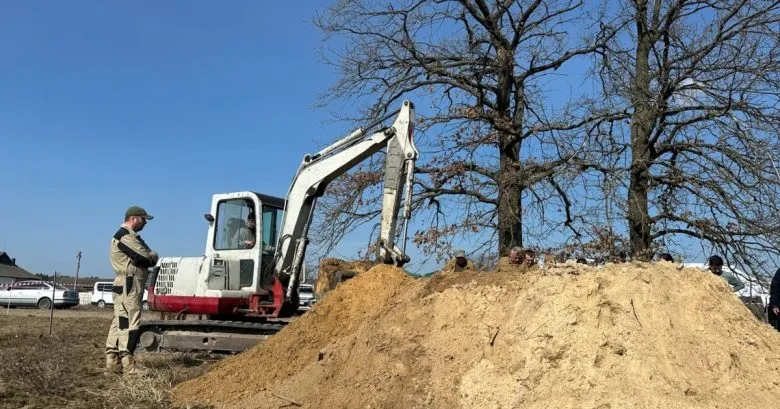
In the village of Uhly in the Sarny district of Rivne Oblast, large-scale search and exhumation work has begun, organized by a joint Ukrainian-Polish expedition consisting of twenty specialists. The main task is to find the victims of the tragic events during World War II.
This is reported by Finway
Initial Discoveries and Expert Participation
During the initial work using an excavator, human remains were discovered. Since the search is taking place on the territory of a former cemetery, the specialists cannot yet accurately determine to whom these remains belong. The Ukrainian side is represented by experts from the Lviv Memorial Search Center “Dolia,” while the Polish side is represented by specialists from the Pomeranian University.
The exhumation was initiated by Polish public figure Karolina Romanowska, whose family members are buried in a mass grave in Uhly. According to her, on May 12, 1943, 18 people were killed, and her great-grandfather, who was the village head during the German occupation, buried about 70 Ukrainians and Poles in the cemetery among the oaks.
“This search is important for me and my entire family because I have heard about it since childhood; it is important for me to find them and give them a dignified burial,” says Karolina Romanowska.
Historical Context and Assessments from Both Sides
The work will continue until March 27 of this year, as reported by the head of the “Dolia” center, Sviatoslav Sheremeta. Polish researchers indicate that the number of victims in the village of Uhly ranges from 60 to 104 people and associate these events with attacks by the Ukrainian Insurgent Army (UPA). According to Polish data, the attack was carried out by a unit led by Nykon Semeniuk, known by the pseudonym “Yarema,” but the exact number of the dead and those who managed to escape remains unknown.
In 1921, the Polish authorities began settling Uhly and other villages in the Volyn region with settlers—Polish colonists, including reservists and participants of the Ukrainian-Polish war. They were granted privileges and land for farming, which created additional tension in the region.
According to Ukrainian historians, mass killings in these areas intensified in the Sarny and Kostopil districts. During the interwar period and World War II, the USSR actively conducted anti-Polish propaganda among the local population, exacerbating interethnic conflicts.
The Organization of Ukrainian Nationalists, which initiated the creation of the UPA, aimed to restore Ukrainian statehood, while the Polish government-in-exile in London viewed Volhynia as part of Poland. The USSR sought to drive the Poles out of these lands, and Soviet leader Joseph Stalin exploited the historical enmity between Poles and Ukrainians, as well as the shortcomings of German occupation policies, directing sabotage groups to the region to carry out terrorist acts.