

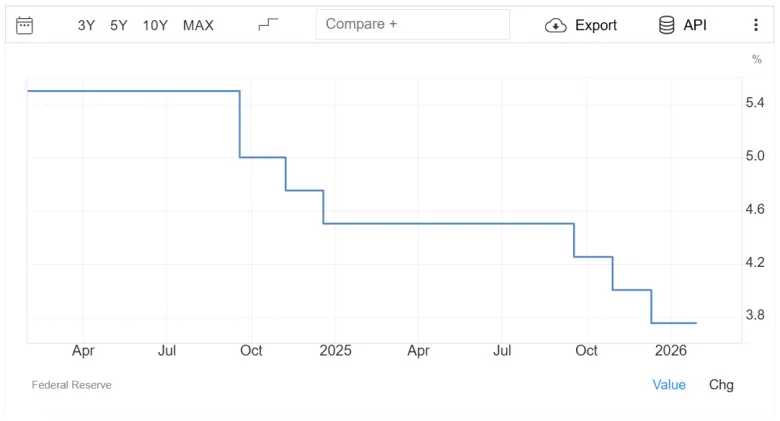
The Federal Reserve of the United States held another meeting of the Federal Open Market Committee (FOMC) on January 28, 2026, during which it decided to keep the key interest rate at 3.5–3.75%. This anticipated decision is driven by the need to stabilize the economy and the labor market. The likelihood of further easing of monetary policy is currently assessed as low.
This is reported by Finway
Market Reaction and Bitcoin Dynamics
Following the announcement of the meeting results, financial markets reacted with a noticeable decline. The price of Bitcoin fell below the $88,000 mark, after which a slight recovery was observed. This reaction is linked to the continued firmness of the Fed’s monetary policy, which traditionally impacts risk assets, including cryptocurrencies.

Since September 2024, the Fed has gradually lowered the key rate, reducing it by a total of 1.75%. Most recently, at the beginning of December 2025, the regulator cut the rate by 0.25%. The regulator has now decided to pause further reductions and maintain the current level.

The next FOMC meeting is scheduled for March 17–18, 2026. According to forecasts from the CME exchange, 86.4% of market participants expect the current interest rate to be maintained, while only 13.6% anticipate a further reduction of 0.25%.
Key Points from Fed Chair Jerome Powell’s Speech
After the meeting, Jerome Powell held a press conference, reiterating the need to balance between reducing inflation and supporting maximum employment. He noted that the US economy is entering 2026 “on a solid foundation,” although there are certain challenges, particularly regarding job growth.
“The Fed is committed to simultaneously reducing inflation and achieving maximum employment. Powell explained the regulator’s cautious approach to policy as a necessity to balance these indicators.”
- Economic activity is growing at a steady pace, consumer spending is stable, and investment in fixed capital is increasing. At the same time, activity in the housing sector remains weak.
- The government shutdown in the fourth quarter of 2025 negatively impacted economic indicators, but the Fed expects this effect to be offset.
- The unemployment rate in December 2025 was 4.4% and has remained virtually unchanged in recent months.
- The regulator notes a slowdown in labor force growth, particularly due to immigration policy, which affects the dynamics of new job creation.
- Inflation has decreased but remains somewhat elevated due to rising prices in the goods sector, driven by tariff policies. Short-term inflation expectations have also decreased.
- Maintaining the interest rate at the current level should contribute to the recovery of the labor market.
- The outlook for the Fed’s future policy remains rather optimistic; however, decisions regarding the interest rate in the near term have not yet been made.
- The trajectory of US public debt remains unstable.
- The Fed emphasizes its full independence in decision-making.
When asked about the US Department of Justice investigation, the election of a new Fed chair, and political issues, Powell declined to comment.