

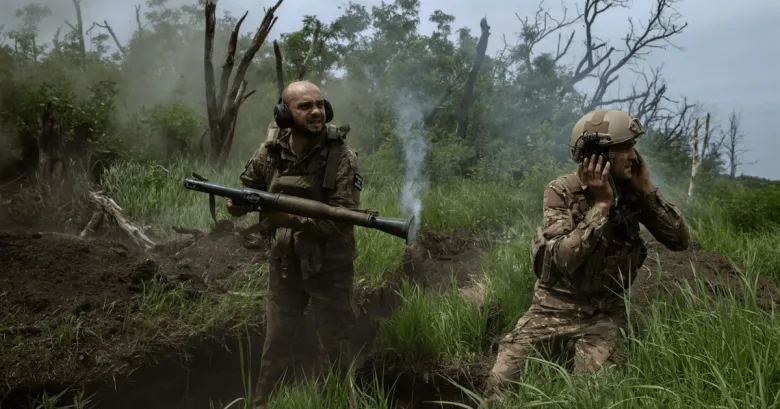
In spring, the Russian Federation intensified military operations on the Ukrainian front, attempting to regain the initiative lost during the winter battles. Following the successful counteroffensive of the Armed Forces of Ukraine in key areas, the Russian army seeks to exploit changes in natural conditions for its own purposes.
This is reported by Finway
Vegetation Cover — A New Factor in the War
With the warming and the emergence of leaves on the tree lines, it becomes easier for troops to conceal their movements from reconnaissance drones, which are actively used by both sides of the conflict. According to military personnel, Russia has an advantage in personnel and material resources and is trying to use this in conjunction with natural conditions. In particular, foliage helps to mask units advancing in small groups along the tree lines in eastern and southern Ukraine, where there are almost no large forests.
“The leaves on the tree lines, which are still relatively intact, will significantly reduce visibility, making it more difficult to detect the enemy. But it will also complicate the enemy’s ability to detect our positions,” said Major Vladislav Vishatyuk of the 14th Brigade of the National Guard of Ukraine, who is fighting near Myrnohrad in Donetsk region.
Commander of the First Separate Assault Brigade of the Armed Forces of Ukraine, Dmytro Filatov, emphasizes that the advantage from the appearance of leaves will be greater for the Russian army, as it has more infantry. This allows the enemy to suffer fewer losses and to conceal themselves more effectively during attacks. This is especially true for areas along the Dnipro River in Zaporizhzhia, where dense vegetation provides additional cover for the accumulation of forces and conducting maneuvers, especially after the reservoir dried up due to the destruction of the Kakhovka Hydroelectric Power Station in 2023.
Scenarios of Combat Operations and Threats to Cities
Military experts predict that the trend of intensified Russian attacks this spring will repeat itself, as it did last year. According to Dmytro Filatov, the Russian Federation may achieve some local successes; however, a breakthrough of the front is not expected. Analysts add that winter conditions favored the defenders more, as the lack of vegetation and frosts complicated the movement of the occupiers.
Ukrainian military personnel are most concerned not so much about the potential advancement of the enemy as about the proximity of Russians to civilian cities. The situation in Sloviansk and Kramatorsk, which are located less than 20 km from the front line, is particularly alarming. Despite the continued Ukrainian control over the cities, the safety of over 250,000 residents remains in question due to constant shelling and drone attacks. Last month, authorities were forced to announce the evacuation of children from some areas of Sloviansk due to the rising threat.
The tree lines, a legacy from Soviet times for protecting fields, are now being used by the military as cover from enemy fire and routes for regrouping or retreating. At the same time, Ukrainian forces continue to strike enemy positions — recently, Ukrainian drones destroyed two “Shahed” bases in Russia.