

The NEAR Protocol blockchain network plans to implement post-quantum cryptography by the end of the second quarter of 2026, specifically in June. This was announced by the project’s co-founder Ilya Polosukhin, confirming the launch of the new signature system in the test network.
This is reported by Finway
“NEAR is implementing post-quantum cryptography by the end of the second quarter so that everyone has time to upgrade.”
The Threat of Quantum Computing to Blockchains
Most modern cryptocurrencies, including Bitcoin, use elliptic curve-based cryptography (ECDSA/secp256k1). However, these algorithms can be broken using a quantum computer, particularly due to Shor’s algorithm.
In March 2026, Google presented a new report on quantum risks for cryptography. The study showed that breaking 256-bit elliptic cryptography requires 20 times fewer quantum resources than previously thought — less than 500,000 physical qubits. Google also developed two quantum algorithms: one uses fewer than 1200 logical qubits and 90 million Toffoli gates, while the other uses 1450 qubits and 70 million gates. A zero-knowledge proof (ZKP) was also provided.
A significant contribution to the research was made by the Eigen Labs team. In particular, undergraduate student Gautam Anant, with no prior experience in quantum technologies, was able to double the performance of Google’s public algorithm using OpenAI Codex. He also created the platform ecdsa.fail for experimenting with algorithms. Naik from Eigen Labs used several artificial intelligence models simultaneously, achieving 80% efficiency of Google’s closed algorithm.
Google predicts that cryptography will become vulnerable to quantum attacks as early as 2029, and EigenCloud’s research supports the realism of this prediction.
“Let me explain: this alone will not lead to the hacking of Bitcoin. It reduces the number of qubits and logical gates needed to create a quantum computer capable of doing so, thus accelerating the development of quantum technologies. In any case, it is time for the Bitcoin community to consider the post-quantum cryptography period,” emphasized the founder of EigenCloud.
NEAR Protocol’s Strategy for Post-Quantum Protection
Following the publication of Google’s report, in May 2026, Near One’s CTO Anton Astafiev clarified in a blog that NEAR is transitioning to post-quantum cryptography. He emphasized that the industry can no longer rely on a multi-year buffer before quantum computers appear, and protection should be implemented in advance.
“As an industry, we can no longer assume that we have time to figure everything out, or that a workable quantum computer will only appear decades from now,” he stressed.
Currently, NEAR Protocol uses EdDSA (Ed25519) and supports ECDSA (secp256k1), neither of which is resistant to quantum attacks. In the future, the network plans to transition to FIPS-204 (ML-DSA, formerly CRYSTALS-Dilithium), approved by NIST in August 2025. This algorithm is based on mathematical lattices rather than elliptic curves.
Importantly, the NEAR architecture allows for the addition of multiple keys to an account. To implement a post-quantum signature, the user will need to add another key based on ML-DSA, allowing transactions to be signed in a quantum-resistant manner. This avoids the need for a large-scale migration or hard fork, although new technical challenges arise — notably, the increased signature size (ML-DSA — 2420 bytes compared to 64 in Ed25519), which impacts computational resources and transaction costs.
Testing of the new approach will begin this month in the NEAR testnet. The date for implementation in the main network will depend on the results of testing and the effectiveness of the new technology.
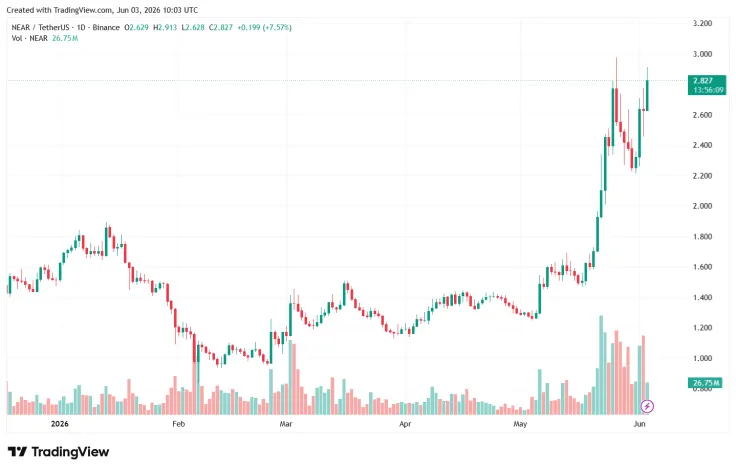
In light of the update announcement, the NEAR token is showing positive dynamics: its price has increased by 7.7% over the past day and by more than 10% over the week.

Previously, the Coinbase exchange also published its own report on quantum risks for blockchain networks and ways to mitigate them.