

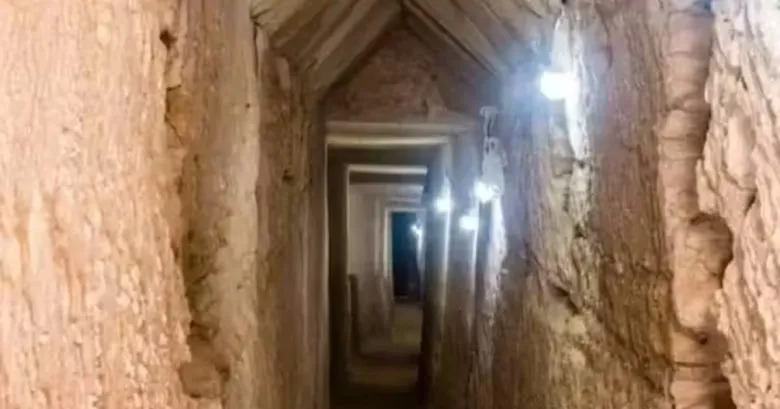
During archaeological excavations in the ancient city of Taposiris Magna, archaeologists uncovered a unique underground tunnel that researchers have dubbed a “geometric marvel.” The discovery was made by Kathleen Martinez from the University of Santo Domingo (Dominican Republic) along with her team while studying a temple located 13 meters underground.
This is reported by Finway
Details of the Tunnel Discovery
The tunnel, carved into a layer of sandstone, is two meters high and stretches for 1305 meters. Archaeologists note its similarity to the famous Eupalinos tunnel on the Greek island of Samos, which dates back to the 6th century BC. The construction of the Greek tunnel is considered one of the most remarkable engineering achievements of antiquity, and the new find in Egypt, according to scientists, rivals it in scale and craftsmanship.
According to the Egyptian Ministry of Tourism and Antiquities, part of the tunnel is currently flooded, complicating the determination of its purpose. However, Kathleen Martinez, who has been researching Taposiris Magna for over 20 years, suggests that the tunnel may be key to the search for the lost tomb of Cleopatra VII.
Historical Context and Findings
The city of Taposiris Magna was founded around 280 BC by Ptolemy II, the son of the legendary general Alexander the Great and an ancestor of Cleopatra. Scholars believe that the temple was dedicated to the god Osiris and the goddess Isis — a deity with whom Cleopatra had a special connection. Evidence of this includes the statuettes of Isis found on site, as well as coins depicting the images and names of Cleopatra and Alexander the Great.
“According to scientists, the purpose of the tunnel remains unknown, as part of it is still submerged underwater. However, Martinez, who has been working in Taposiris Magna since 2004 in search of the lost tomb of Cleopatra VII, considers the tunnel a promising lead.”
Further exploration of the tunnel may answer the question of whether it leads to one of the legendary tombs. The team of archaeologists also plans to investigate the surrounding Mediterranean area, as historical sources indicate that between 320 and 1303 AD, a series of earthquakes occurred along this coastline, partially destroying the temple and submerging it underwater. Previous excavations have already revealed a network of tunnels connecting Lake Mariout to the Mediterranean Sea.
Among the artifacts found in the tunnel are a rectangular limestone block and fragments of pottery that may shed light on the further history of the temple and its purpose.